Showing posts with label Travel. Show all posts

Wednesday, July 26, 2017

Seek, Discover and Explore


The focus of the fourth Madhya Pradesh Travel Mart is to highlight Madhya Pradesh as a year round travel destination

  The 4th edition of Madhya Pradesh Travel Mart with the theme of Seek-Discover-Explore will be held at Bhopal from October 27 to 29 this year. Around 200 national and international buyers and about 100 representatives of distinct Indian markets are expected to participate in it. The main objective of this mart is to promote the Madhya Pradesh as a destination throughout the year. The mart will provide a B2B platform which will bring tourism stakeholders on a platform where they would interact to explore opportunities of mutual trade. The event is being supported by eminent institutions of tourism and hospitality industry including Adventure Tour Operators Association of India, Indian Association of Tour Operators, Travel Agent Association of India and Federation of Hotel and Restaurant Association of India.
“The Travel Mart is an opportunity in which the tourism aspects of the state and the policies and schemes are conveyed to the investors. In the last 3 years of the Travel Mart in Bhopal, it has been experienced that through this one-to-one discussion with tourists, tourism, hospitality and participants of the hotel industry, the efforts being made for the expansion of the area are also being underlined,” said Hari Ranjan Rao, Secretary, Tourism and Public Service Management, Managing Director, M.P. State Tourism Development Corporation, Madhya Pradesh Tourism Board.
The last edition was highly successful with around 8 crore visitors out of which around 6 lakhs were foreign tourist. This year the number is expected to around 9 crore with many international participants like Singapore, Spain, United Kingdom, United States of America, Netherlands, Germany, Norway, Thailand, Poland, Austria, Australia and France.


Read More

Wednesday, July 19, 2017

A living legend

Monuments teeming with history, delicious food and a luxurious stay ~ all these made Rakesh Kumar’s weekend trip to Agra an unforgettable experience


Just 250 km from the Capital, with several travel options and a strong pull, a visit to Taj Mahal, one of the world’s most visited monuments, had been eluding me for years. Quite often it was just a narrow miss that kept me from one of the Seven Wonders of the world. Thanks to an office assignment, I got a chance and ample amount of time to visit Agra city, which houses not just the Taj Mahal but other monuments that have a lot of history attached to them.

Pages of history


Agra, once the Capital city of Mughal India, had played a significant role in Indian history.  One can find many descriptions of the city right from Mahabharata era to Mughal or Lodhi dynasty. The different dynasties bestowed on Agra a time graph through its numerous forts, mosques, step wells and gates. Among these some of them like the Taj Mahal, Agra Fort and Fatehpur Sikri come under the ambit of UNESCO world heritage sites.
 Our tryst with Agra began on a Saturday morning. Initially we planned to go by the newly launched Gatimaan Express, which reaches Agra in just 100 minutes. However, as tickets were not available, we took to the road and after almost four hours and three toll gates reached the historical city. As we entered the city, images of the Mughal era that we had read or seen in movies, started opening up before us. We imagined Emperor Akbar walking along the congested lanes of Agra, or Shah Jahan walking to the Yamuna Bank to monitor the progress of the Taj Mahal. We pictured how Agra Fort would be abuzz with people.

The hotel


Our first task was to look for a good place to stay and our search ended at Radisson Blu, Agra, which was our home for the next two days. Staying at Radisson Blu, Agra, had its advantages. The foremost was its location. The luxury hotel is conveniently located near the Agra Fort and at walking distance from the Taj Mahal. Apart from this, the property, which is surrounded by 4.5 acres of land with 142 luxury rooms and suites, boasts of many latest amenities like sparkling outdoor pool, the Health Club, Spa, a business centre and restaurants offering  the finest world cuisine, traditional culinary and rustic barbeque at the poolside.
 Our room was comfortable and well-decorated, including fresh flowers and lovely artwork. But the best part was the fashioning of the towels in the shape of the Taj Mahal. This encouraged us all the more to visit the Taj Mahal as soon as possible.

The city


After lunch and a short rest, we headed out to explore the city. Our first instinct was to head for the Taj Mahal. But the hotel staff advised us not to go in afternoon but early morning. They informed that the white structure looks more attractive in the morning and also changes into a golden colour with the first rays of sunlight.
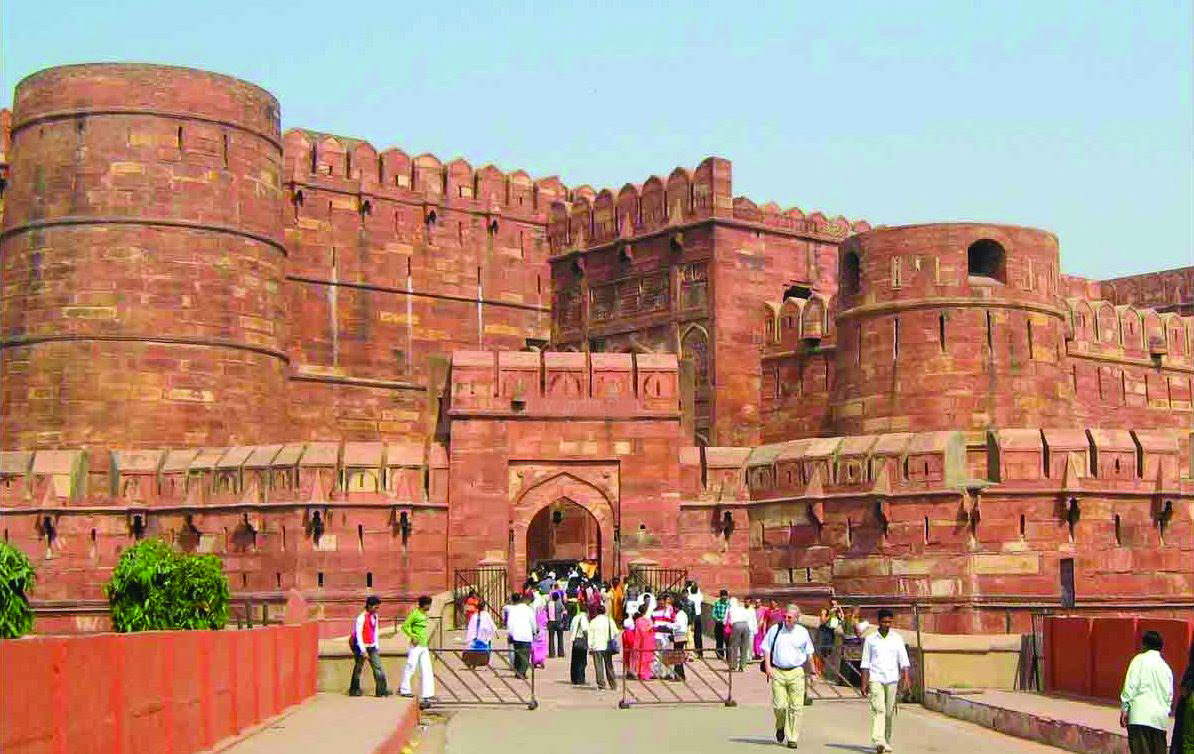
 Taking the staff’s word we then visited the Agra Fort. The fort, also known as Lal Quila, was the abode of the Mughal dynasty and is now known as the sister monument of the Taj. The red sandstone structure was built by Emperor Akbar. It took 4,000 workers to build it in eight years. The fort has four large gates and is divided into different palaces ~ Moti Mahal, Sheesh Mahal, Jehangir’s Palace and Khas Mahal. Apart from its impressive architecture and design, the fort also bears the fascinating history of the Mughals. Shah Jahan renovated it by adding marble work and converting the raw red sandstone structure into a palace. His son Aurangzeb imprisoned him in the same fort at Mussaman Burj.  After exploring the fort, we visited the Sadar Bazar ~ the famous market of Agra and Mehtab Bagh.
 Back at the hotel, we were asked by the manager to be ready by 6 am next morning, if we really want to see the Taj Mahal in a golden colour. At the same time, he recommended the Noor-e-Taj show ~ an audio-visual show organised by the hotel, which gives an insider view of the Taj Mahal.

 Next morning we were ready by 5.30 am. There was a huge queue outside the main gate of the Taj. Surprisingly, they were mostly foreigners, armed with their mobiles and cameras. After much pushing and shoving, we finally managed to enter. Passing one more red gate, the pure white structure lay before us. Is it the legendary Taj Mahal? For a few moments, everyone kept gazing the structure, which is the most beautiful monument I have ever seen in my life. Now it was a time to steal the moment. Like everyone else, I took out my camera and clicked away. People were jostling to take best shot of the Taj or with the Taj. As the sun rose, with every angle of the sunlight, the Taj Mahal changed its colour from pure white to gold. We lingered there for two hours before returning to the hotel.
 Soon it was evening and time to take the Gatimaan Express back to Delhi. Throughout our journey, the only thought running in mind was why we were keen to get back the Kohinoor, when a living Kohinoor is present in Agra ~ the Taj Mahal.

http://www.thestatesman.com/travel/a-living-legend-1485610258.html
#travel #tajmahal #weekendgateways 

Read More

Saturday, March 14, 2015

Colour Kerala

The coffee and tea plantations of Wayanad, as also its rich tribal culture, beckoned rakesh kumar

We were asked to get ready very early, around 6 am, if we wanted to really feel the essence of coffee plantatione. The local guides said, be it plantations, animal sanctuary or anything connected with nature, morning is the best time when they look more beautiful. Thus, it was nothing but our love for coffee, which led us to leave our cozy bed early in the morning, ignoring the cold winds. We were at Vythiri Village Resort, in a small hill station at Wayanad, in Kerala. Wayanad, which means paddy fields, falls in South Kerala. Unlike North Kerala, this part doesn't have rice boats, backwater cruises, sandy beaches, colonial churches or thatch-roofed fishing villages. But this small hill station is rich in coffee or tea plantations, the largest tribal population with a distinctive culture, an 800-year-old Jain community, home stay and much more beyond sight seeing. 
 Our  day began at the coffee gardens near our resort. Interestingly, in many areas of this region, one side of the hill had coffee plantations while the other side housed tea gardens. Since it was a morning time, we came across many women, with baskets on their backs, busy plucking tea. Our guide, who also worked at our hotel, informed us that here in Wayanad district, coffee plants could be found in every house, growing lush on any piece of land. The  climate in the area is perfect for cultivating coffee and tea. Therefore, this place has also earned the title Coffee County of Kerala.
All about coffee
Robusta and Arabica are the two major varieties of coffee grown in this region.
The coffee plant is an evergreen shrub, which can grow to 20 ft in its natural state. However, the tree is regularly trimmed to 6 ft for production to keep the nutrients from going to the tree rather than the beans. When the coffee berries are a rich, red colour, they are ready for harvesting. Each berry contains two seeds, which are processed to make coffee. 

After having a first hand experience of coffee plantations, our next visit was to a tribal village. Just a 20-minute drive from our hotel, took us to the interior of a jungle, away from the main populace. We had to stop our car in the middle of jungle, walk ten more minutes, climbing down grassy slopes and wading across streams, to reach a small village of Paniya tribes.
This settlement has only ten houses of bamboo-and-mud-plaster huts with thatched roof. Interestingly, all of them own some amount of land, on which they grow pumpkin, pepper vines, turmeric, ginger and tapioca. We were told that the Paniyas fall under the lowest strata, even among the tribals, therefore, they avoid mingling with the mainstream. Agriculture is their mainstay of livelihood. But they also work as farm labourers.
 
Jain temples
 

The next day, we visited the Jain community, which has a very significant presence in Wayanad region. They are said to be migrants from Karnataka, when Jainism went into a decline there, some 800 years ago. We visited one of the temple ruins,  Janardhanagudi temple at Panamaram, dating back to the 12th century. Though it has been taken over by the Archeological Survey of India, it is in a pathetic state. At the temple, there was a heap of granite blocks covered with carving lying by the side of the road and blocking access to the three roofless temple mandapas, their pillars too ornamented with curvaceous yakshis, fierce dwarapalas and amorous figures. A Jain community member said these temples were demolished by Tipu Sultan. 

The visit cost us almost half the day. We ended our visit with the Wayanad Coffee County, run by Ranjini and Rajagopal Menon. It was a dream home and we didn't know how the time flew. Situated in a 12-acre land, the house is blessed with greenery including tea garden, coffee plantation, coconut and areca palms. The courtyard boasts a swimming pool and leads on to a pavilion perched over a gurgling rivulet. Rajdeep and Ranjini's hospitality was like icing on cake. A must visit place.
Read More

Thursday, December 25, 2014

On a spiritual note

Even as celebrations in pubs and bars ring in the new year, rakesh kumar notices another growing trend ~
people heading for the temple


Ram Niwas Shastri, in his 40s, booked a ticket to Vaishno Devi for his family, which includes two kids and his mother, at least two months ago for the New Year. His only argument for doing so is that he wants to spend the first day of the year on a spiritual note. According to him what could be better than visiting a temple. "I could have easily afforded a leisure vacation on hill stations or at the sea shore. But it was my family's desire to start the year on a religious note. Therefore, we decided a trip to  Vaishno Devi to kickstart the new year," reasoned Shastri, who is an engineer by profession and well-paid.
This is not a stray case. Take the example of Krishna Pophale, a Mumbai- based pharmaceutical businessman, whose family also wants to visit some temple on this day. Therefore, he was planning to visit Shirdi temple in Mumbai. The family thinks the first day of the year is very auspicious; therefore visiting a temple is the best option. "What is the first thing we do after buying a house, vehicle or anything new? Or what do we do when we start a new business or go for a job the first time? In all the cases we visit a temple, don't we? Like this, we also want to visit a temple on New Year," opined Pohphale.
Going by the Indian tradition, it is true that before starting anything fresh, visiting a temple is deemed as a good omen. Therefore, it seems that in this new year, inspite of many heading to the hills, sea or another city, a number of people would prefer a temple or religious place to begin their new year. Earlier, people seemed to be more interested in visiting exotic places like Andaman and Nicobar Islands, Goa, Kerala, Shimla, Manali, Sikkim or Ladakh, but now new trend of visiting holy places is also taking shape. Shuomo Mukherjee from the Key Hotels and Key Resorts totally agreed with this trend. "We have 15 hotels and many are at religious places like Mahabaleshwar, Shirdi and Tirupati. Surprisingly, all our hotels are packed with 80 per cent occupancy. This confirms the new trend ~ people love to visit some spiritual place than some other place," said Mukhejee, chief marketing officer of Key Hotels. "Moreover, on this day, we get many requests from our customers to facilitate the temple visit."


During Christmas week, which goes on till the dawn of the new year, people remain in a holiday mood. As per Thomas Cook India, a travel planner company, the upcoming New Year holiday offers opportunity for short breaks and has further fuelled demand, resulting in an impressive upswing of over 26 per cent for international holidays. As the Indian traveller is conventionally a last minute planner, the expected number could increase further by about 10-12 per cent. Another travel website, Yatra.com informed that there is 40 per cent hike in bookings compared with last year. "However, recently, newer destinations such as desert, heritage, waterfront and even pilgrimage destinations are being explored as leisure holiday spots, and will account for 50 per cent share in all holidays planned in the upcoming year," said Hari Nair, founder and CEO, HolidayIQ.com.
However, Sharat Dhall, president of Yatra.com, has a different take on it. He agreed there are a number of people, who like to visit the temple on 1 January but not in such numbers that one could call it a trend. "Of course, many prefer the religious destination but that is not the only case. Still people prefer those destinations, which are short distance destinations and unexplored."

Read More

Wednesday, December 17, 2014

Celebration for all

India is known as the land of festivals, with some celebrated across the land and others relegated to a region or state. But now, an intermingling of celebrations can be seen as several festivals cross borders and set off gaiety all over the country. Rakesh kumar sees a cause to celebrate some of these unifying festivities


They say nothing binds people together like celebration. And if it is a festival where members of all communities can participate, the bonds are further strengthened. Of late, there have been several such festivals, which were regional to begin with, but have panned out across the country. Then there are some common festivals that are celebrated in different ways.
 This year, when Delhi government declared a government holiday on Chath, a festival widely celebrated in Bihar and some parts of Uttar Pradesh, the move brought cheer among the community hailing from those states. Though many termed this to be a political stunt to increase voter bank, at the same time it defined the outreach of the festival. What was till a few years back limited to a particularly state, has now widened its horizon and reached the Capital, where a gala event is held. In fact, it is not only the Chath, but there are many such festivals like Diwali, Holi, Durga Puja and Raksha Bandhan, which were initially celebrated either in one or two states but have now spread throughout the country, some of them even crossing border s. Blessed with a multi- cultural population, India has numerous and varied festivals, that are held throughout the year.


Land of festivals
Since India has always been a land of diversity, there are numerous religions, languages, cultures and castes. Each month is crowded with people celebrating fairs and festivals. Different religions have their own cultural and traditional festivals. Each and every festival is celebrated uniquely, according to rituals and beliefs. Each festival has its own history, legend and significance of celebration. For instance, it is a belief that Hindus have a holiday for every day of the year ~ even that may be an understatement! Exactly how many Hindu festivals are celebrated is not known, but one scholar of Hinduism has listed more than a thousand different Hindu festivals. The other  major religious faiths ~ Muslims, Sikhs, Jains and Christians ~ too have their share of festivals around the year.


Not merely religious


 Till recently, festivals were limited to their respective religions, like Diwali or Holi used to be celebrated by Hindus, Eid by the Muslims, Guru Purab only by Sikhs and Christmas by Christian only. However, over time and with a change in mindset, other communities now join in the festivities. For instances, Holi or Diwali are now celebrated by all. People can be seen colouring others or distributing sweets irrespective of their religions. On Eid, Guru Purab or Christmas, the same fervour can be seen in the celebration among all communities. Not just this, many festivals have not only crossed the boundary of religion but also states. Earlier, many festivals, which were only celebrated in one state, are now being celebrated all over the country though the way they are observed may be a bit different.
 A major divide is between South and the North, with each region having its unique festivals and also common festivals celebrated differently. South India has a culture inherited from the Dravidians, which is different from that of Aryans. However, with Aryans having migrated to South India ages ago, a mixing of culture and traditions has taken place. Now, because of migration and influence of people traveling to other parts of India and vice-versa, this intermingling is reflected in festivals as well.
 However, not many South Indian festivals, such as Pongal and Onam, have found their way outside the state borders even though the migrant population in other states celebrate them in the traditional manner. However, the spirit behind the harvest festival Pongal is reflected in Makar Sankranti, which is celebrated in several other states, including in the North.

Origin of festivals
As already mentioned, there is no exact list of all the festivals in India. However, there are many festivals, which owe their origin from a particular part of the country and travel around. A number of them, which were unknown to the rest of India, have now become pan-Indian celebrations. There is a long list of such festival including Holi, Krishna Janmashtami, Govinda, Onam, Ganesh Chaturthi, Diwali, Navaratri, Dussehra, and Durga Puja.

Common celebration
Some religious faiths like Christians and Muslims are spread across the country. Their festivals ~ Christmas, Eid and Easter ~ are common to the respective faiths no matter where they are. However, slight differences in celebration can be noticed from state to state. The same goes for the Sikhs, Buddhists and Jains, who are today spread across the country.

Holi 


Holi is a festival of colours, which starts with a Holika bonfire on the night before Holi, where people gather, sing and dance. The next morning, people colour each other with dry powder and coloured water, with some water guns and coloured water-filled balloons for their water fight. Holi is of particular significance in the Braj region, which includes locations traditionally connected with Lord Krishna ~ Mathura, Vrindavan and Banaras.

In other parts of the country, the festival is being celebrated differently but with the same fervour. In Gujarat, UP, Bihar and Madhya Pradesh, the festival is celebrated like the rest of India, by sprinkling coloured water and applying colours to each other. However, South India did not traditionally have this festival. Now Holi is celebrated in South India too, though limited to cities, with as equal a vigour as in the North.


Diwali

This is another major festival, which is celebrated with much gaiety in North India. The day commemorates the return of Lord Ram to Ayodhya after his exile. Usually, on Diwali, the goddess Laxmi, a symbol of prosperity, is worshipped, people wear new clothes, share sweets and light firecrackers. This is how the festival of lights is traditionally celebrated all over India. However, in South India, it is celebrated with the same fervour, but with a different history. It commemorates the victory of Lord Krishna over the demon Narakasura.

This day is celebrated as Deepavali (Diwali in the North) and it usually falls a day before the Diwali in North India. On this day, houses are cleaned, decorated with beautiful Rangoli designs on the doorstep. An elaborate oil bath is taken early in the morning before firecrackers are set off. Given the number of people who have migrated from North to South, the festival has witnessed a drastic change in the way it is celebrated. Now, people of South India are not only celebrating Deepavali the traditionally way but also the way the North celebrates it ~ with illuminationas and bursting firecrackers.


Durga Puja

Durga Puja is a ceremonial worship of the mother goddess and is one of the most important festivals of India. The festival marks the victory of Goddess Durga over the demon Mahishasura. Thus, Durga Puja festival epitomises the victory of Good over Evil.

The rituals entail ten days of fasting, feasting and worship. The last four days ~ Saptami, Ashtami, Navami and Dashami are celebrated with much grandeur. Durga Puja is mainly celebrated in the Indian states of West Bengal, Bihar, Assam, Jharkhand, Orissa, Tripura and Manipur. 

 Apart from eastern India, Durga Puja also marks its presence in other parts of the country. For instance, in northern parts of the country, where the 10-day festivities end with Dushera, Ram Leela is staged on all the days and effigy of Ravana burnt on the last day. But pandals for Durga Puja crop up across several cities. The same is true in Gujarat and Maharastra also, where playing Dandiya is their main form of celebration. These states too organise Durga Pandals in different parts of major cities. Similarly, other states like Uttar Pradesh, Punjab, Kashmir, Andhra Pradesh, Karnataka and Kerala, organise Durga Puja as a part of their celebration thanks to a sizeable Bengali population.


Janmashtami

This is a celebration to mark the birth of Lord Krishna. The festival is celebrated in the North by fasting and staying up until midnight, when Krishna is believed to have been born. At midnight, devotees gather around for devotional songs, dance and exchanging gifts.

 In Uttar Pradesh, places associated with Krishna’s childhood, such as Mathura, Gokul and Vrindavan, Rasa Lila, depicting the life of Krishna is enacted on this day. However, residents of Dwarka city in Gujarat, where Krishna is believed to have spent his adulthood and established his kingdom, celebrate the festival by visiting the Dwarkadish temple. Many states like Maharashtra and Gujarat organise a Dahi Handi, to celebrate Krishna's playful and mischievous side, where teams of young men form human towers to reach a pot (handi) of butter strung up high. Lately, the Dahi-Handi celebration is seen in several other states too.


 Ganesh Mahotsav

Ganesh Mahotsav or Ganesh Chaturthi is celebrated to mark the birth of the elephant-headed God, Lord Ganesha. The 11-day festival witnesses much fanfare in Mumbai or western part of the country. On the occasion, most Hindu families install their own small clay statues for worship on Ganesh Chaturthi. As per the tradition of respective families, the domestic celebrations come to end an end after 11 days, when the statue is taken in a procession to a large body of water such as river or sea for immersion. Apart form Maharashtra, the festival is celebrated with the same fanfare in the southern states of Tamil Nadu, Karnataka and Andhra Pradesh too. Now, the elephant god has stomped across several other states too, where the festival is celebrated with the same pomp and ceremony.


Karwa chauth

It won’t be wrong to say this is a festival, which gripped the whole country in just a short span of time. One this day Hindu married women fast from sunrise to moonrise for the longevity of their husband. The festival is mainly observed in the states of Punjab, Haryana and other northern parts, but now other states like Uttar Pradesh, Himachal Pradesh, Chhatisgarh, Madhya Pradesh, Jharkhand and Western Bihar are observing it too.

In the South Karwa Chauth was not heard of, but thanks to TV serials, which insert a scene depicting this festival in a bid to lengthen their script it is slowly but surely gaining ground


Read More

Saturday, September 13, 2014

Inviting tourists

Encouraging response from Indian tourists in the last six months has led Abu Dhabi to organise five roadshows in India to lure more tourists, reports rakesh kumar


After getting an overwhelming response from Indian tourists in the last two years, Abu Dhabi Tourism is now seeking to cash in on this segment of tourist arrivals. In a bid to reach out to a larger number of Indian tourists, Abu Dhabi Tourism and Culture Authority (TCA) has organised travel and trade roadshows across five Indian cities ~ Bengaluru, Mumbai, Ahmedabad, Chennai and Delhi. With the help of these roadshows, the Gulf country hopes to generate a high level of interest as a multi-faceted, unexplored and exotic destination for the aspirational Indian travellers. 
"Destination Abu Dhabi is fast becoming the new hot-spot for the high-end Indian travellers," said Bejan Dinshaw, country manager, TCA Abu Dhabi, India. "We enjoy a historic and cultural connect between our two countries. Abu Dhabi offers the charms of the Yas Island entertainment hub, Saadiyat Island cultural district, the historic Al Ain Oasis and the Qasr Al Sarab Desert Resort luxury oasis. The unparalleled array of interesting itinerary options makes Abu Dhabi a compelling destination." 

The response from the Indian market has been encouraging for Abu Dhabi. In the six months from January to June, a total of 107,995 Indians visited the country, clocking a growth of 35 per cent over the same period last year. These visitors delivered 408,862 guest nights at a growth rate of 22 per cent over the same period last. The other reasons that Abu Dhabi gives a credit to growing tourists from India is one of its most iconic landmark ~ the famous Sheikh Zayed Grand Mosque, which was recently voted second in TripAdvisors' Travellers Choice awards for outstanding landmarks. 
"The upcoming roadshow emphasises our continued initiatives with all stakeholders on a pan-India level, when we hope to leverage on the emirate's increasing affordability with value through a highly competitive average room rate, which now stands at AED348, or just US $95," clarified Bejan. 
Abu Dhabi offers a vast range of attractions for one and all. Its Yas Island is becoming increasingly popular with Indian travellers as a complete entertainment destination. Apart from that, there are several attractions, including Ferrari World Abu Dhabi, the world's only Ferrari-branded theme park with more than 20 rides and the world's fastest rollercoaster, Formula Rossa, reaching speeds up to 240 kmph! 

F1 fans can have a thrilling experience with the state-of-the-art F1 track at Yas Marina Circuit, where petrol heads can drive a Formula Yas 3000 or Aston Martin GT4 around the same circuit as the pros. 
Yas Waterworld ~ featuring 43 rides, slides and attractions spanning a sprawling 15-hectares ~ is an award-winning water park. Soon to open, just prior to this November's Formula 1 Etihad Airways

Abu Dhabi Grand Prix, is the eagerly awaited Yas Mall, which will be the emirate's largest shopping mall. Along with this, the country also hosts many top-of-the-line renowned events throughout the year. Among the most popular events are: November's Formula 1 Etihad Airways, Abu Dhabi Grand Prix and Abu Dhabi Art; January's Abu Dhabi HSBC Golf Championship; and the Abu Dhabi International Triathlon in March.
Read More

Wednesday, September 3, 2014

Explore the unexplored

As popular tourist destinations lose their charm thanks to increasing crowd and commercialisation, the trend is towards new unexplored places for a holiday. Rakesh kumar trudges the road less travelled

 Gone are the days when holiday destinations meant places like Shimla, Mussourie, Agra, Jaipur or Manali. For those who could afford it, they would book a trip to a limited set of foreign destinations for a holiday with their family or friends. Now, a new trend is gaining ground, particularly among the younger crowd, to visit less explored destinations. It’s not uncommon for youngsters to take their car and go where their will takes them, and stop wherever they like, irrespective of the food or lodging available. “Mainly youngsters between 21 to 30 years of age are passionate about these sort of trips,” informed Rajan Sehgal, president of Delhi-based Tour Operators' Associations. 
“Moreover, they hardly care for any bookings, hotels or facilities available. They form a group, take out their car and go out.” Needless to say, India is a diverse place, where one can find a variety of places, with rapidly changing geography, language and people as one traverses through various parts of the country. Each part has its own charm ~ in the north one will find snow-capped Himalayas, in the west one can encounter the desert, South India is famous for its coastal areas, islands and temples while eastern India is a land of mysterious. Who doesn’t want to explore all these areas? 
 “Tourists are getting very smart now and they don’t want to spend their hard-earned money just to visit the same place every time,” said Vipin Sharma, another tour operator. “They need a change. In that anticipation, they go for unknown places, which often leads to great innovations and discoveries.” Official statistics also substantiate this trend ~ a little over 1,145 million domestic tourists visited different places in the country in 2013 while in 2012 the number was 1045.05 million ~ around nine per cent growth. Take any destination, tourist arrival has increased. “With an increasing middle class population, travel trend has also risen. Now people love to travel rather than keep away money for future,” said another tours operator.


 The other reason for this trend is that popular places are over crowed. These places have witnessed such a huge rush that they have lost their essence. “Be it Shimla, Manali or Mussourie, these places have lost their natural beauty. As they increasingly got crowded, the places became crammed with commercial activities, which also led to loss of charm,” said Rajan Sehgal, pointing to Shimla and Mussourie as examples.
 Many a time, these unexplored destinations also end up as a chance for adventure tourism for the youngsters ~ another reason for their rising popularity. This is what draws many groups to haunted places like Bhangarh, which was recently developed as a tourist spot. At the same time, visiting unexplored destinations have led to discovery of new places, which is no less of an adventure for these youngsters. 
 “When my father made plans for holiday at Nainital, many of us in the family refused,” said Kavita Adhikari, a teacher by profession. “The reason was simple ~ it was a place we had visited so many times that there is nothing new out there.” However, Mohd Shanawaz has different excuse to discover new places rather than visiting the same old ones. “During the long weekend around Independence Day, we made plans for an outing. However, when we tried to book hotels, to our surprise, there were no rooms (cheap) available and those that were quoted sky-high prices.”
During such long weekends and holidays, many hotels and resorts, particularly in the hills, increase their tariffs steeply. Therefore, due to this price factor, many people drop the idea of going to these hill stations. “Yes, it is true that during vacation these places become very costly for common man,” said another tour operator. “Therefore, there is a rising trend of visiting these unexplored places. Moreover, these places are not too far off, therefore, it won’t take much time for people to get back to work.”

Less explored destinations around Delhi
 Dundlod
Around 252 km away from Delhi in the Shekhawati region of Rajasthan is Dundlod. The place is popular for the Dundlod fort~ a blend of Rajput and Mughal architecture. Here one can see the fine mirror work at the Bhagirath Mal Goenka Haveli. The Marwari breed of horses are also bred here and a family arranges for tailor made desert safaris on them.

Pangot
To reach Pangot one will have to travel 13 km from Nainital, it is a beautiful  hill hamlet in the Kumaon region of Uttarakhand. It is a popular summer getaway and tourists flock to this place during winters (November to February) too to witness the snowfall. It's also known for bird watching with over 150 different species of birds.


Pilibhit
 Located 310 km away from Delhi in the state of Uttar Pradesh is Pilibhit, meaning 'Wall of Yellow Mud'. Its border touches the Nepal border and known for the origin of river Gomti. The whole area is densely forest region. Pilibhit is also called Bansuri Nagari and exports majority of India's flutes. It also has a Tiger Reserve that came into existence in 2008.

Shogi
Around 343 km away from Delhi, there is a small hill town Shoghi. It is also known for the temple town as it comprises a small cluster of villages - each with a temple of its own. Some of the famous temples include Tara Devi temple, Hanuman temple and Kali temple. Calm and secluded, this hill station can be taken-up as a cheaper alternative to Shimla.

Kausani
Renowned as Switzerland of India, the beautiful hill resort of Kausani is located at a distance of around 390 km from Delhi. One of the most mesmerizing hill stations in India, over 300 people as inhabitants, this place becomes just the right destination for spending a peaceful vacation.


Read More

Thursday, August 28, 2014

A long weekend

The year 2014 saw a spate of extended weekends as several festivals and public holidays fell around them. Rakesh kumar looks at how people are taking advantage of these short breaks


No longer do people wait for summer of winter vacations to take that outstation holiday with family. There is a now new trend towards short breaks, where one goes out on week-ends. This current year ~ 2014 ~ has been a boon for these “short-break” seekers as several festivals and public/national holidays have fallen before or after a week-end, resulting in a long weekend or a short vacation. This year has eight such long weekends, bringing to a total 53 days, when one can travel out. Though over half the year has lapsed, there is still a chance to take that long break for those who haven’t gone out so far. 
 The frequent long weekends have given rise to a new trend and there is a rush among people going on a short holiday instead of long ones.

 "Since the last few years there is an increasing trend for short holidays during such long weekends," said a Delhi based tour operator. "We are already witnessing increased bookings for destinations close to Delhi-NCR. Among the most favoured places is Jaipur, followed by Manali, Shimla, Nainital, Amritsar, Agra and Corbett."   
  The last long weekend that stretched from 15 August (Independence Day) and went on till 19 August, came as a boom for many travel operator all over the country. During this weekend, many such operators said they had got several enquiries for nearby destinations for their “staycations”. "Before this Independence Day weekend, I got numerous calls from people enquiring about travel packages for this weekend," said another travel operator. 

 The next long weekend is from 2 October (Gandhi Jayanti), which is followed by 3 October (Dussehra), Saturday and Sunday, and ends on 6 October (Bakr-Id). A fine time to pack one’s bags, say tour operators. The same opportunity is available during Diwali and New Year. "A long weekend is the perfect time to get out and breathe fresh air, especially after being relatively sequestered inside all week," said Sharif Ahmed, who has planned a surprise trip for his family during the next weekend. 
 Over the years, long traditional holidays have become passé. Fast lifestyles, work commitments and hectic schedules are making travellers opt for quick breaks, which are more convenient. Moreover, it has the health as well as finance importance too. These mini vacations not only require shorter breaks from routine work but are also lighter on the pocket. Taking a mini vacation actually proves to be more beneficial as one feels refreshed and rejuvenated before getting back to the grind. This spurt of weekend bookings has also largely been influenced by flash sales being offered by low cost airlines and hotels, which tempt travellers to book their holidays in advance at discounted rates.  

 If one takes a look at Yatra.com, a travel website, one can see a three-fold increase in the number of travellers opting for long weekend holiday packages. Weekend destinations such as Goa, Coorg, Lonavla, Mcleodganj, Rishikesh and Jaipur have seen a tremendous increase in bookings for the upcoming long weekends, showing that the Indian traveller is now keen on taking frequent short breaks in addition to the longer summer and winter vacations. 

 "Another good part of taking a short trip to a destination that is only an hour or two away is that this is a great way to visit a new place, but doesn't require too much travel or planning," said Mahender Yadav, a businessman from Delhi.
Read More

Thursday, August 21, 2014

A royal procession

Teej festival of Rajasthan is not limited to swings, henna or dressing up in traditional clothes but goes way beyond, discovers rakesh kumar


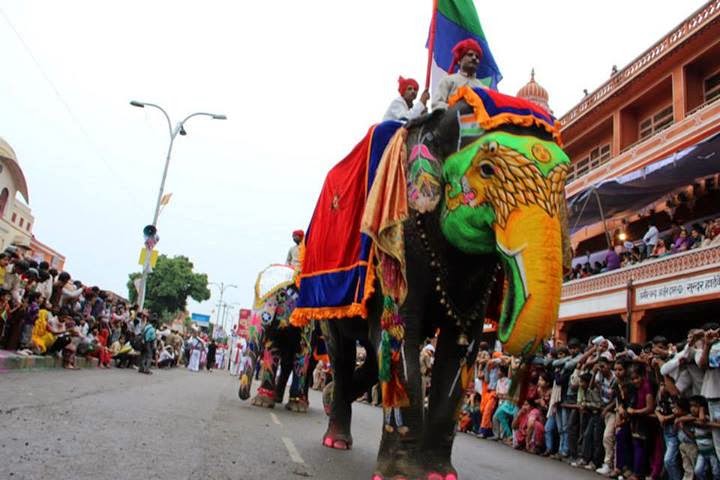
It was a huge procession of decorated elephants, adorned camels and colourful horses, along with the cannon carriage, bullock carts, horse-drawb buggi and well-decorated rath. Seeing all these, one might imagine standing in a royal palace. Indeed, one would not be far off the mark as the place is a Land of Kings and Queens ~ Jaipur in Rajasthan.
Rajasthan is not only famous for its rich royal culture or lush green forest but for its festivals too. The occasion was the colourful festival Teej, which is all about the reuniting Goddess Parvati and her husband Lord Shiva. The other significance of the festival is the beginning of monsoon in this dry state.
On 30-31 July, on the occasion of Teej, the whole city wore a festive look. Our tourist guide from Rajasthan Tourism informed us that festival has a very old legacy, more than a century old. On this day, an idol of Goddess Parvati (Teeja Mata) is taken out in a royal procession from the City Palace so that the general public can have a chance to pay homage to the Goddess. All the year, the Teej Mata is under wraps at the home of the royal family, only on this occasion, it comes out.
 Meanwhile, some of us were eager to have a look at the preparations taking place inside the palace ground and we had a plenty of time to do so. The scene inside was rather attractive, or to say, it was worth spending one hour inside. On one side, there was a row of elephant standing there all decked up, with lions and deer painted around its eyes and legs. Their mahouts got busy throwing a sheet and then few other adornments over these giants. There were a few camels and horses as well. In one corner was a group of women dressed in finery, all in black, and a few men playing music.
 After spending some time watching, clicking photographs and talking to the people around here, we finally made our way to the main road in search of a vantage point to view the procession. The sitting arrangements were made on the terrace of the Hind Hotel opposite Tripoliya Gate, where there was a row of chairs filled with foreign tourists. Luckily, despite a huge crowd, mostly VIPs, we grabbed our seats. Every now and then, there would be a sudden bout of drizzle.
Suddenly, sounds of a band emanated from the Tripoliya gate followed by a procession of painted elephants, looking grand and beautiful. Following them were different cultural performances like Kachchi Ghodi, Gair, Kalbeliya and Chakri dances. The procession also included cannon carriage, bullock carts, horse buggi and decorated rath. A number of bands also accompanied the procession. Then finally came the palanquin of Goddess Parvathy, which was a beautiful red canopy pulled by eight men dressed in their finery.

This kilometre-long procession wound its way through the lanes of the Old City (City Palace), meandering through Tripolia Bazar, Chhoti Chaupar and Gangauri Bazaar to wind up at the Chaugan Stadium. Unlike VIPs, who were on the roof, many local people dressed in their best traditional clothes made their way to the lanes to witness the fervour. All in all, the festival is a mix of colour, dance, music and mouth watering cuisine, particularly Ghewar. In another words, Teej of Rajasthan is not limited to women on swings or applying henna, but goes beyond.


Read More

Friday, August 8, 2014

Thailand beckons

With Thailand facing a tourist slump, the country is gearing up to woo visitors, particularly from India, reports Rakesh Kumar 

 
The recent political turmoil in Thailand may have been a deterrent to those planning a holiday there. Yet, the country is not ready to give up on its "most preferred travel destination" tag. With tourism contributing around nine per cent of its GDP, Thailand is keen to send the message that all is well and tourists are as welcome as before.
"Can you imagine a country facing political upheaval holding domestic  festivals back to back?" asked
Runjuan Tongrut, director, Tourism Authority of Thailand (TAT). "No...this is a sign of a (peaceful) country."
In the first four months of this year, Thailand has seen a five per cent dip in tourist arrival and officials expect this figure to rise further. As for Indian tourists, every year around one million visitors have been holidaying in Thailand. However, due to political unrest in the country, their footfall is likely to decrease. But Tongrut, who was in India for a roadshow, remained optimistic. "For the past three years, we have been getting around one million Indian tourists. This year too, we are expecting the same number."
In the roadshow held in the Capital last week, Tourism Authority of Thailand (TAT) showcased a whole gamut of products and services, ranging from culture and entertainment options to theme parks as well as health and wellness, from tour operators to airlines and hotels. Pointing to the continued interest of tourists to Thailand, Tongrut explained how the country offered a lot by way of wedding celebrations, golf, health and wellness, adventure sports as well as women's programmes.
"Over 100 Indian weddings have been held in Thailand over the past few years and celebrations such as birthdays, anniversaries and graduation parties are being held in Thailand," said the director. "And day by day, we are getting more inquiries in this area, showing that the situation is normal."
Among other initiatives that Thailand is taking to encourage Indian tourists, festivals are organised to coincide with their holidays. These festivals include Dok Krachiao Blossom Festival, Rafting in Pai River, Amazing Thailand Grand Sale, Suphan Buri's Tulip festival and much more.

After Delhi, the Thailand Tourism roadshow will visit Jaipur and Bhubneshwar to apprise people there about places of tourist interest such as Ayutthya, Sukhothai , Khao Yai, Rayong, Koh Chang, Chantaburi, Koh  Samui, Koh Tao, Koh Pha Ngan, Krabi, Phuket, HuaHin/Cha-am, Pranburi,  Kanchanburi, Trang, Chiang Mai and Chiang Rai.
Read More

Saturday, August 2, 2014

Joy for women

Teej is mainly celebrated in north Indian states but is now popular in Delhi, Chattisgarh and Madhya Pradesh, reports Rakesh Kumar

Every year, the third day after Shravana month of the Hindu calendar is celebrated by married women across much of North India with much gaity and enjoyment. The auspicious day of Teej is a much anticipated monsoon festival, which commemorates the reunion of Lord Shiva and Goddess Parvati, after her 100 years of penance. The three-day festival, which marks for the well being of the family, is mainly celebrated in north Indian states ~ Uttar Pradesh, Bihar, Rajasthan, Haryana and Punjab in different styles. Now it is also observed in Delhi NCR, Chattisgarh and Madhya Pradesh.
 Every state has different take on this festival. For instance, Teej has a broader significance in Rajasthan, where it is observed to provide relief from the scorching heat of summer. Rajasthan Tourism organises a Teej fair called Sawan Mela or Monsoon Festival every year to showcase the customs and traditions of the state during this time. Teej is also celebrated as a major festival in Nepal. At the famous Pashupatinath Temple in Kathmandu, women circumambulate the Shiva Linga and offer special prayers to Shiva and Parvati. A day before, this festival is celebrated as Sinjara, where young girls and women apply mehandi, or henna, on their hands and eat sweets such as Ghevar. They take out a procession in the streets singing and dancing. We take a look at how Teej is celebrated in different states.

Haryana 
In Haryana, on girls apply mehandi on their hands and feet. Married women get gifts, including new clothes, from their parents. The gift, known as baya, also consists of a variety of foodstuffs. The gift is placed on a thaali at the place of worship, usually a chowk (square), which is gaily decorated and an idol or a picture of Parvati installed. The evening is full of singing and dancing and includes prayers by the women for their husbands' longevity and their families.


Rajasthan 
Teej is also known as a festival of swings. On this day women, dressed in green colour, swing to their hearts’ content, accompanied by songs. To mark the festival, Rajasthan Tourism organises an elaborate procession in Jaipur for two consecutive days on the festive occasion, watched by people in large numbers. The Teej idol has a canopy overhead whereas the Gangaur idol is out in the open. The traditional Ghevar sweet is also an inseparable part of the festival.

Punjab 

In Punjab, Teej is celebrated as Teeyan. The whole month of Sawan sees women getting together to perform Giddha and enjoy the swings hung from trees in the village communal land. Like Haryana, it is customary for married women to receive presents from her family in the form of new clothes and sweets.
Read More

Wednesday, July 9, 2014

Take a break


Holidays and vacations have taken a new meaning with people now opting for short weekend breaks at off-beat destinations closer to home. Rakesh kumar explores some of them

Weekend is no longer a mere break in the office routine, when one relaxed at home with family or friends It has taken a whole new meaning with outings becoming a growing trend in India, particularly with the young, who would rather spend quality time at some holiday destination than turn into couch potatoes at home. Reasons for this change in attitude are plenty but the average Indian domestic traveller is becoming more experienced, adopting the characteristics of evolved and discerning travellers both in behaviour and travel purchases. “Down the years, there has been a huge growth in the outings c

ulture and the credit goes to none other than the advent of corporate culture. Thus, you would notice these days, every other office goer making plan for a break in some hill station or nearby tourist destination rather than killing time at home,” pointed out Gajender Singh, general manager of Hotel Hiva in Alwar.
However, a Delhi-based tour operator has a different take on this. “We agree that the corporate sector played a vital role in promoting outings culture among Indians. But another factor is the growing affluence of middle class, compared with earlier. Now people are more open in terms of spending money. They do not mind spending on tourism related activities.”
According to a report, India Tourism Market and Future Forecast (2009-15) domestic tourism is expected to increase at an annual compound growth rate of 12.29 per cent in 2008-15. At the same time, this sector could generate the second largest number of jobs in the country in the coming days.

Love for adventure
Just a few years ago, a holiday for an Indian meant typically a trip to the nearest hill resort to escape the heat of the plains, or a weekend break at the beach. But now people sweat away hard-earned vacation mountaineering, paragliding, rock-climbing, scuba diving, skiing, trekking, and white-water rafting have. In addition to leisure holidays, spiritual tourism and short weekend breaks are popular among Indian travellers. In fact, adventure tourism has grown by 65 per cent world over last year.
 “Earlier during summer vacation or any other long holidays, we would get inquiries for travel packages. But now, the scenario has totally changed and people ask for tour packages for weekend. And most of the inquiry is for adventure activities,” said a tour operator. 


Not far from home
Where once popular tourist destinations such as Shimla, Mussorie, Nainital and Agra were sought out, now the taste has changed. People love to explore places closer to home for a two-day holiday as it saves time and are cost effective. There are a number of such places near Delhi NCR, for instance ~ Western Resort Country Club, Manesar; Golden Huts, Heritage Village, Manesar; Pratap Garh Farms, Magsons Resort, Kosi; Damdama lake; Fun ‘n Food Village; Surjivan resort, Manesar; Turtle Farm Resort, Gurgaon; Aapno Ghar, Manesar; Fun Town; Camp Wild, Dhauj, Faridabad; and Classic Golf Resort, Gurgaon. Moreover, other places gaining popularity are Amritsar, Chandigarh, Chail, Jaipur, Gwalior, Khajuarao, Neemarana and Jodhpur.
“Over the last 10 years, there has been a dramatic shift in the mind-set of people in terms of wanting to explore and go beyond the regular adventures that they normally take,” said the tour operator.

Corporate culture

A major factor, which spread the love for weekend travel among the people, is the growing multi-national companies. As per their strategy, they engage the hearts, minds, and hands of their employees with the trips to nearby areas. “To make our customers happy, we have to make sure our employees are happy first,” said Sharif Ahmed, Team leader of IBM. “The atmosphere at workplace can positively or negatively affect a worker’s performance, hence one good way to build and maintain the company’s culture is through opting for team outing.”


Some favourite destinations for a weekend getaway:
Bharatpur (Rajasthan)
Apart from the birds sanctuary, the place is famous for forts, palaces  and
Mughal and Rajput architecture visible almost everywhere.

Corbett National Park
The Park is located in the foothills of the Himalaya, in the midst of lush greenery and uneven mountains with varying heights, ranging fromabout 1,300 feet to nearly 4,000 feet above sea level.

Jaipur

The Pink City of Jaipur proliferates in its magnificent past, bellicose history, renowned tradition, architectural elegance andnatural vista.

Mount Abu (Rajasthan)
The cool and fragrant ambience with rich flora in Mount Abu attracts thousands of tourists every year.

Khajuraho (Madhya Pardesh)
A historic city widely acclaimed for its lovely temples with erotic sculptures, Khajuraho is located in the woody plains of Bundelkhand region and readily accessible from across the country.

Pushkar (Rajasthan)
Pushkar is one city in India that everybody knows and wishes to visit someday. This sacred city of Hindus is only 10 km from Ajmer in Rajasthan


Read More