Monday, July 24, 2017

Not so uncultured

Chic interiors, innovative food and ample rooftop space are just a few things one can look forward to in Uncultured Café and Bar, writes Rakesh Kumar 

Ever since the Municipal Corporation of Delhi asked restaurants in Connaught Place not to use rooftops, restaurants with rooftops in other areas took advantage. People love dining under an open sky and mist fan. Away from Connaught Place, in Kailash Colony, Uncultured Bar and Café has started attracting many patrons, courtesy its large rooftop. Tucked in the midst of the bustling Kailash Colony market, Uncultured is a casual, chic and European-style restaurant. Even though the whole market is dotted with many shining billboards of restaurants offering various cuisines, Uncultured Café and Bar stands out among them. Located on the first floor, the restaurant has a quirky and comfortable ambiance and rooftop area. The restaurant's indoor area is kept quite simple. Inside the restaurant there's subtle lighting, a little artificial greenery and cane baskets with dried flowers on the walls. The walls are full of colourful posters and graffiti. Seating arrangements are cozy with leather indoors and cane chairs outdoors and cabanas on the roof-top. There is a separate zone for kids also. Games like ball pool, castle of blocks, video games, puzzles, rides and puzzles keep the kids entertained throughout.

 The restaurant's menu offers food from all over the globe, including American, Mediterranean, European and Indian culinary. It is filled with food ranging from Pizzas, Pastas, Kebabs, Wraps and Sliders to Street Food, Indian Classics, Continental and Oriental.
 Usually we avoid ordering salad as our first meal in any restaurant, but it was highly recommended by restaurant's manager. we chose Indo-Caesar Salad, which was quite fresh, and indeed the best way to begin. Once done with the Salad, there was a deluge of dishes on the table. Betroot ki Chaat, where beetroot was baked and dressed with several chutney and spices, was good to taste but not the best. Then it was the turn of Gol Gappa. It was served quite impressively: there were syringes filled with different chutney and test tubes carrying flavoured water. However, it was no match to the roadside Golgappa, except for hygiene and presentation. Then we were served Butter Chicken Croquets ~ balls of chicken decorated with herbs and spices. Grilled Prawns were just average. One can go for Chilli Garlic Fish instead. There are plenty of drinks options ~ one could start with Weekend Uncultured, then try Double Spicy Twist and Pan Badshah should be the last. It has a refreshing taste of Paan. 
 In the main course, one can start with Mutton Rogan Josh ~ it was the chef’s recommendation and really tasted well. For vegetarians Chilli Soya Chaap can be a good choice with Chur Chur Naan. Amritsari Makhni Chicken had lots of butter ~ if health conscious, better avoid it. Overall, the restaurant deserves a visit, at least for its large open dining area.
Table for two: Rs 1,500 (approx.) with alcohol

Address: Uncultured Cafe And Bar
HS-12, Kailash Colony Rd,
Block K, Kailash Colony, Greater Kailash,
New Delhi-110048
Contact No: 011 30806654


Read More

Sunday, July 23, 2017

Might and Majesty


Aqua Loins 3, the new offering of Intex comes with 2.5D curve DragonTrail glass, big battery, Android 7 OS and the SwiftKey Keyboard.

Intex Technologies, a leading mobile handset makers introduced a new feature-rich, powerful and stylish 4G-Volte smartphone~ Aqua Lions 3. In partnership with SwiftKey by Microsoft, the Android 7OS powered device comes with a smart keyboard that will make typing 22 Indian languages easy and cool.
Priced at Rs. 6499, the phone is 4G-Volte smartphone comes with a 5-inch HD IPS OnCell display supported with a 2.5D curved glass. The display is well protected with the super tough DragonTrail glass, one of the best for protection and sturdy usage. The device is powered with a 1.25GHz quad-core processor and 2GB RAM, ensuring smooth performance while playing high-end games, watching videos and multitasking. The device is powered with a big 4000mAh Li-Ion battery.
 “With Aqua Lions 3 smartphone, we are not only providing the best specs, but also with SwiftKey keyboard integration enabling Intex’s diverse consumers from different parts of the country the freedom and joy to express themselves in their mother tongue. Intex has always designed products keeping in mind consumers’ needs & demands and Aqua Lions 3 model will surely be a delight,” said Ishita Bansal, Product Head - Mobiles, Intex Technologies.
For photography enthusiasts and selfies lovers the phone has 8MP (AF) selfie and 8MP (FF) rear camera powered with Front LED & Rear LED flash to click bright pictures even in low light zones. It has in-built 16GB ROM with an expandable memory of up to 128GB, that ensures no more space constraints. The device is available in two premium colours~ Champagne and Black.


Read More

Wednesday, July 19, 2017

A living legend

Monuments teeming with history, delicious food and a luxurious stay ~ all these made Rakesh Kumar’s weekend trip to Agra an unforgettable experience


Just 250 km from the Capital, with several travel options and a strong pull, a visit to Taj Mahal, one of the world’s most visited monuments, had been eluding me for years. Quite often it was just a narrow miss that kept me from one of the Seven Wonders of the world. Thanks to an office assignment, I got a chance and ample amount of time to visit Agra city, which houses not just the Taj Mahal but other monuments that have a lot of history attached to them.

Pages of history


Agra, once the Capital city of Mughal India, had played a significant role in Indian history.  One can find many descriptions of the city right from Mahabharata era to Mughal or Lodhi dynasty. The different dynasties bestowed on Agra a time graph through its numerous forts, mosques, step wells and gates. Among these some of them like the Taj Mahal, Agra Fort and Fatehpur Sikri come under the ambit of UNESCO world heritage sites.
 Our tryst with Agra began on a Saturday morning. Initially we planned to go by the newly launched Gatimaan Express, which reaches Agra in just 100 minutes. However, as tickets were not available, we took to the road and after almost four hours and three toll gates reached the historical city. As we entered the city, images of the Mughal era that we had read or seen in movies, started opening up before us. We imagined Emperor Akbar walking along the congested lanes of Agra, or Shah Jahan walking to the Yamuna Bank to monitor the progress of the Taj Mahal. We pictured how Agra Fort would be abuzz with people.

The hotel


Our first task was to look for a good place to stay and our search ended at Radisson Blu, Agra, which was our home for the next two days. Staying at Radisson Blu, Agra, had its advantages. The foremost was its location. The luxury hotel is conveniently located near the Agra Fort and at walking distance from the Taj Mahal. Apart from this, the property, which is surrounded by 4.5 acres of land with 142 luxury rooms and suites, boasts of many latest amenities like sparkling outdoor pool, the Health Club, Spa, a business centre and restaurants offering  the finest world cuisine, traditional culinary and rustic barbeque at the poolside.
 Our room was comfortable and well-decorated, including fresh flowers and lovely artwork. But the best part was the fashioning of the towels in the shape of the Taj Mahal. This encouraged us all the more to visit the Taj Mahal as soon as possible.

The city


After lunch and a short rest, we headed out to explore the city. Our first instinct was to head for the Taj Mahal. But the hotel staff advised us not to go in afternoon but early morning. They informed that the white structure looks more attractive in the morning and also changes into a golden colour with the first rays of sunlight.
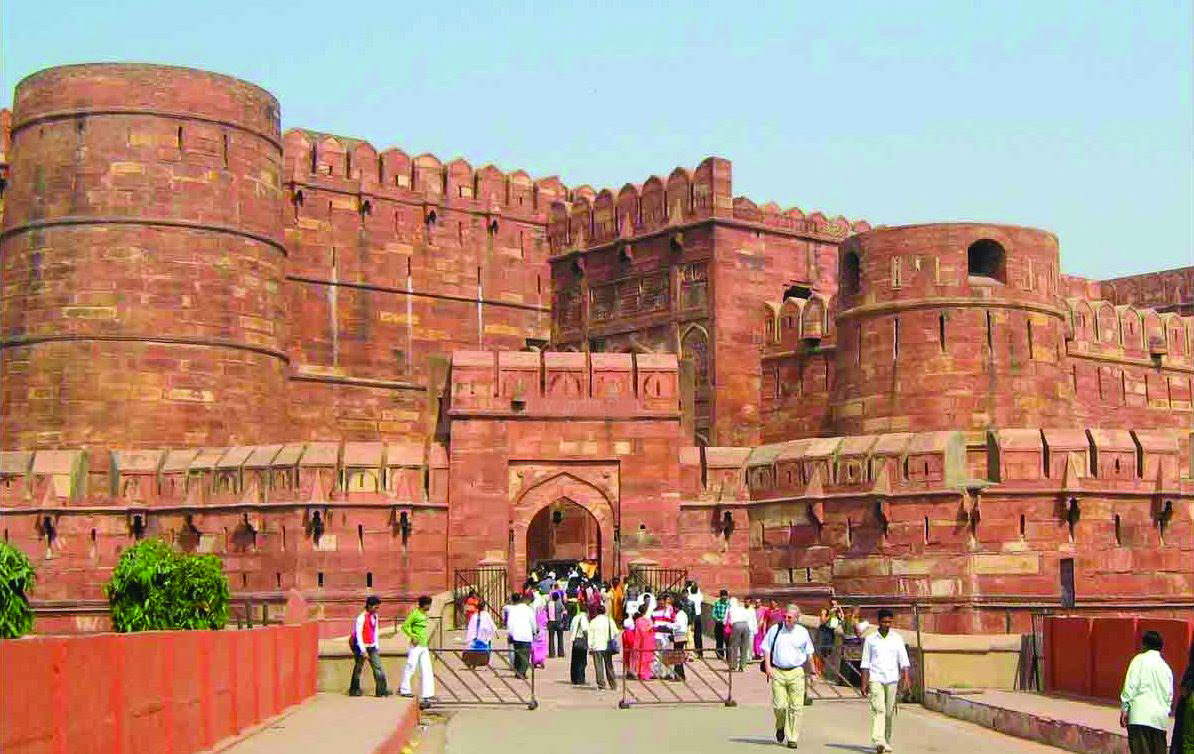
 Taking the staff’s word we then visited the Agra Fort. The fort, also known as Lal Quila, was the abode of the Mughal dynasty and is now known as the sister monument of the Taj. The red sandstone structure was built by Emperor Akbar. It took 4,000 workers to build it in eight years. The fort has four large gates and is divided into different palaces ~ Moti Mahal, Sheesh Mahal, Jehangir’s Palace and Khas Mahal. Apart from its impressive architecture and design, the fort also bears the fascinating history of the Mughals. Shah Jahan renovated it by adding marble work and converting the raw red sandstone structure into a palace. His son Aurangzeb imprisoned him in the same fort at Mussaman Burj.  After exploring the fort, we visited the Sadar Bazar ~ the famous market of Agra and Mehtab Bagh.
 Back at the hotel, we were asked by the manager to be ready by 6 am next morning, if we really want to see the Taj Mahal in a golden colour. At the same time, he recommended the Noor-e-Taj show ~ an audio-visual show organised by the hotel, which gives an insider view of the Taj Mahal.

 Next morning we were ready by 5.30 am. There was a huge queue outside the main gate of the Taj. Surprisingly, they were mostly foreigners, armed with their mobiles and cameras. After much pushing and shoving, we finally managed to enter. Passing one more red gate, the pure white structure lay before us. Is it the legendary Taj Mahal? For a few moments, everyone kept gazing the structure, which is the most beautiful monument I have ever seen in my life. Now it was a time to steal the moment. Like everyone else, I took out my camera and clicked away. People were jostling to take best shot of the Taj or with the Taj. As the sun rose, with every angle of the sunlight, the Taj Mahal changed its colour from pure white to gold. We lingered there for two hours before returning to the hotel.
 Soon it was evening and time to take the Gatimaan Express back to Delhi. Throughout our journey, the only thought running in mind was why we were keen to get back the Kohinoor, when a living Kohinoor is present in Agra ~ the Taj Mahal.

http://www.thestatesman.com/travel/a-living-legend-1485610258.html
#travel #tajmahal #weekendgateways 

Read More

Culinary flights


Frequent fliers often have complain about the food served on the flight ~ one may want to improve the taste of the sandwich, the dosa may not be crispy, the curry too thick or the quantity of food not enough and not tasting as it should. But little does one know how this food is processed and reaches the passengers.
Unlike food on the ground, which is served soon after it is cooked, flight foods have to go through several processes for it to stay fresh and nutritious for several hours.
It takes around at least 18 hours to prepare a single meal and making food tasty in the sky is the major challenge for chefs.
The food served in the plane has to withstand several fluctuations in temperatures, swinging between extreme and moderate, from the moment a meal is cooked or prepared in the kitchen to the time it is served to a passenger. Just like a flight control room, these kitchens too have a control room to know all the flight details. “Which flight is coming next?
Which flight will be flying where? What would be the passengers' preference?
All these one has to take care of in this control room,” explained general manager of Taj SATS, Shashi R Sinha. One has to keep in mind a lot of things before serving food on the flight. International Airline Virgin Atlantics informed that a lot goes into preparing food to be served at 35,000 ft.
“People eat with their eyes before they eat with their mouths, so colours and textures create anticipation of the tastes to follow meaning the visual appearance of a dish is vital," informed the spokesperson from Lufthansa. "We also need to make sure our cabin crew is able to create the dishes and present them to our customers in the aircraft. We also take into consideration the weight and packaging sizes, cooking time and the food safety elements of the storage on-board." Why so tasteless?
Scientifically, while flying high, the humidity in the cabin drops by around 15 per cent, which make sense of smell and taste decrease by 20-25 per cent. Therefore, the transport of smell and taste to the brain becomes slows. At this height, the taste of salt and sweet also decreases.
Therefore flight food is high on salt and sweet. In a bid to maintain the taste in the sky, airlines have to work a little harder. Take for example Virgin Atlantic Airlines, which selects products with a stronger flavour profile to ensure that they are not tasteless on the flight.
"We create recipes that take into account the air pressure and humidity levels aboard an aircraft. We do not add additional salt or pepper ~ the increased flavour profiles are achieved through natural ingredients," said a spokesperson of Virgin Atlantic Airlines.
The same goes with the German airline Lufthasana, which works with natural aromas such as fresh herbs, spices and reductions (such as tomato reduction) to enhance the flavours and make food tasty and healthy. In the kitchen The story of flight food is complicated ~ usually, in international flights, destination determines the nature of food while in domestic routes it is timing.

A recent trip to Vistara Airlines' base kitchen in the Capital revealed the intense planning that goes into processing and delivering food to the planes.
Food is cooked round the clock in the vast kitchen of Taj SATs, situated in Aerocity Delhi. More than 700 dishes are readied in its kitchen, including breakfast, lunch, dinner, snacks and desserts.
Usually the staff start preparing food 18 hours prior to a flight as it has to go through several processes. Once the raw material is received, the first task is to check the quality, cleaning norms, temperature management and expiry dates. This is done by the quality assurance team.
Raw vegetables are kept in chlorine water for some time to sanitize them.
For packaged material or other ingredients, there is a separate staff dedicated to open them and check thoroughly. There are many dos and don’ts the kitchen staff has to keep in mind while preparing the food. For instance, food has to be delivered within 18 hours of preparation.
Managing temperature is also a major challenge. The science behind preservation says food is free from any biological attacks as long as it is warm (up to 72 degree Celsius) or cold (5 degree Celsius).
"Every activity is time bound here. And if the time pattern is not followed the food can go waste," the general manager of Taj STATs informed. "I will give you an example of this raw meat ~ it has to be readied at 15 degree within 45 minutes." The vast kitchen is divided into different parts ~ in Taj STATs they call it islands.
For instance, some islands are meant to prepare food for business-class food, some are meant to cook breakfast or some will cook only vegetarian or only non-vegetarian.
To demarcate them, the kitchen uses different colours of cutlery sets to cook different food. Green is meant for vegetarian, yellow for chicken, red is for meat and blue is for sea food.

“Serving food on flights is one of the most difficult parts. We have to keep so many things in mind. We have limited space and weight of food ~ we can’t exceed it. Therefore, we try to serve less liquid items like dal or curry. Other than this we also have to (keep an eye on) everything, like how food looks, forks, knives and cutlery apart from many other things," Arun Batra, the executive chef of Taj SATS.
The business-class meal of Vistara weighs around 300 gms per meal and economy class food weighs approximately 220 gms per meal. And this does not include soft drinks. Tea/coffee and juices weigh about 80-100 ml and water is 200 ml. "Not only this, we even test the calorie count," the chef added.
Once the food is ready, the most important task is to bring all the hot food from 72 degree Celsius to 15 degree, within four hours.
The food is shifted from hot kitchen to cold kitchen, where it is kept in a freezer for four hours to "cold soak".
The food is then transported to meal bank in trolleys. As the flight timing approaches, the food is taken out of the meal bank. Taj SATS also carries out a Hazards Analysis Critical Control Point test (HACCP), wherein food samples are sent to their in-house lab to test for food poisoning.
In the last one hour, they do the final packing before dispatching. Even before finally transporting the trolley, the food is again randomly checked to find out the types or class it belongs to.
Once the security passes the food, these trolleys are sealed. High lifts, named special vans, take the food to various destinations. The packages are opened only when they reach the plane.
"Even a little difference in temperature can change the taste and texture of food," the Vistara chef said. Once the whole process is done, dishwashing is equally important.
Usually, the dishes and cutlery are sanitized at 82 degree Celsius. Deciding the menu The food in-charge of Vistara, a Singapore-based airline, which serves 9,000 to10,000 meals in a day in its entire network, informed that season played an important role in deciding and changing the menu.
Their menu is finalised by the food and beverage industry in a series of brain-storming sessions and a thorough research goes into identifying the latest food trends. Usually the menu is changed twice a year ~ once in summer and then between October and November, with the onset of winter.
But preparations for every change starts three to four months in advance. "We keep certain things in mind before deciding the menu.
For instance, for an early morning flight from Delhi to Mumbai it is understood that most passengers will be travelling for work. So we make sure that the meal is light and has the right ingredients. Similarly, dinner is a little heavy, the reason being that a lot of people generally catch flights skipping more than one meal,” informed the Vistara chef. The menu is decided between the chefs and the management team.

Once they are finalized, a sample tasting is organised with the Chief Executive Officer, Chief Strategy and Commercial Officer and Chief Financial Officer, lead cabin crew members and chefs from other regions, as well as others for feedback.
"In Vistara, the menu goes through four cycles of rotation and each cycle is repeated after six days. This ensures a unique gastronomical experience every time one flies Vistara, especially for the airline's frequent flyers,” said the Vistara spokesperson. International carrier Lufthansa informed that they try to fulfill the wishes and expectations of passengers as well as possible. Since they fly all over the world, other than western food they also need to take care of ethnic food specialities such as Japanese, Indian and so on.
"To start the programme we hold a so-called think tank meeting, to collect all kinds of ideas regarding what we want to do and in which direction we might want to go. This involves participants from Lufthansa sales, Lufthansa crew and the Lufthansa product development," informed the airline’s spokesperson.
Once the menu is finalised a briefing is sent to the catering unit that states what they expect to see and what should be prepared.
The menu proposals are sent back to them after two to three months.
Out of the given proposals they select around 100-150 dishes. This is how the menu is curated in every airline. Not only this, the menu has to change according to season and class also.
“Anyone travelling to a destination tastes their first flavours (of the region or country) on-board the aircraft, starting their journey through the food we serve." informed Virgin Atlantic spokesperson.
"We change our Upper Class and Premium Economy food menu every three months, while we change our Economy menu every six months. In our menu selection we like to add a little bit more class to all our dishes and we define a style based on the market trends , driven by demand. We love to curate delicious food with structure, height and a bit of culinary art while keeping it fresh and intriguing."
Read More

Sunday, June 18, 2017

Gamer’s choice

ASUS’ newly launched laptops

ROG GL552 and ASUS G501 in gaming series can be the choice for game enthusiasts, given their specifications and cost. A review by Rakesh Kumar


When Asus added four laptops, including ROG GL552 and ASUS G501, in its gaming series ROG (Republic of Gamers) last time, it had in mind the entire lot of game enthusiasts in the country. Of course, they succeeded to an extent, as the GL552VW is a good offering in terms of specifications and range. However, it has some flaws too, like battery life, which has only four hours of backup. If you watch any movie or Youtube video, the battery will drain fast. The design ~ black metal deck, along with the sinister red backlighting, which ASUS claimed to have been inspired from F22 Stealth Fighter ~ can impress anyone. The only problem with it is that it’s a little chunkier than similar 15-inch-gaming laptop. And it is also bit heavy, making difficult to carry all the time. In terms of performance, the product, with sixth generation Intel Core i7 processor with 16GB of DDR4 RAM (2133Mhz), is quite fast. One can run heavy graphic games like Call of Duty: Ghosts and Need for Speed: Rivals without any problem. The stereo speakers, which feature SonicMaster tech, have little shallow sound in games and music.

Specification
The GL552VW comes with a Quad core 6th Gen intel core i7(Skylake), Nvidia GTX 960M graphics with blazing fast 4GB GDDR5 graphics memory, 16GB memory, a TB of storage along with 128 GB SSD. The screen has 15.6-inch, 1920 x 1080 screen delights with great accuracy, spot-on colours and top-tier brightness. At the same time, Asus ROG GL552 is pre-loaded with Windows 10 Home, Asus Live Update, the Splendid Utility for customizing your display, and the Game First III app that helps prioritize network traffic to make sure you don't lag while gaming. At last in the given range, ASUS ROG 552 is a top-notch gaming laptop.

ASUS ROG 501VW
ASUS ROG 501 is another product, which was launched in this series. The things one is going to like about this product, unlike other gaming laptops, this is thin with high performance in this price range. Despite its light weight and thin body, no compromised were made in among the ports and designs. However, the only problem with the device is its 512GB storage space. Another let-down could be Ethernet port, which is missing and a wire connection provided. All in all, G501VW could be one of the best portable gaming laptops in the market. In terms of design, the product wears an awesome look with brushed aluminum body, with a black, matte-ish paint job. In terms of performance, the device is good, equipped with Core i7 6700HQ processor and is able to handle all tasks with equal ease. One could run dozen tabs or watch video, and won’t face any problem.
Specification
ASUS ROG 501VW is equipped with sixth generation Intel Core i7 processor with 16GB Ram, dedicated NVidia GTX 960M GPU with 4GB memory and a 512GB SSD drive. It has a 15.6-inch 4k display (native resolution of 3840 x 2160 pixels) feature that's still rare in this price bracket. It has three USB 3.0 ports, a full size HDMI output, a USB Type-C port and a card reader.
Read More

A low budget phone


The latest offering of Chinese smartphone maker Coolpad's Mega 3 has many features, which will attract buyers in this price range. But low resolution can let this phone down, writes Rakesh Kumar


In November Chinese smartphone maker Coolpad came up with its new phone Mega 3. Like its predecessor, Mega 3 is also a low budget phone at just Rs 6,999. What is good about the phone is its triple sim and good design. But the phone’s resolution is very low, lacking the punch one requires to watch high definition movies or games. Another drawback of the phone could be its speed, especially when multiple browser, apps or games are opened. Switching between apps could be a little stressful.

Design and storage
The Coolpad Mega 3 is built well and looks good. The phone weighs 170g and is 8.3mm thick. The exterior of the phone is covered with plastic, which is removable and doesn't feel delicate. The good thing about the phone is its coarse finish at the back, which gives a good grip unlike glass. The volume keys are on the left side while the power button is on the right. The purpose behind separating the power buttons and volume buttons is to give people a better idea of where each of them is exactly placed. The other good thing about the phone is that it can support three SIM cards, all of them 4G-ready, at a time.
 The internal storage of the phone is 16GB and one could enhance the storage to another 32GB through a micro-SD card. The battery of the phone has 3,050 mAh, which can run well for a full day with modest usage.
 Unlike other budget phones, the camera of the phone, which is 8-megapixel both in front and back, is not very appealing.  Shots taken in daylight looked decent, with reasonable colour accuracy but a lack of detail.

Software and display
The Mega 3 runs on Android 6.0 Marshmallow with the company's CoolUI skin. There is no app drawer, which means all the apps will be shown on Home screen. But the advantage is one can change the look and feel by applying new themes and wallpapers. The phone has a MediaTek 1.2GHz MT6737 quad-core processor with 2GB RAM. It gives smooth performance, until multiple tabs are opened. In terms of resolution, the 5.5 inch smartphone has a resolution of 1,280x720p, which handles colour well. Visibility from odd angles is good.
All in all, given the specifications, features and price, the phone is impressive in this price range.
Read More

Wednesday, February 1, 2017

'PM broke his fast to taste my vegetarian food'


If one has to prepare a list of top-notch chefs in India, it would start with none other than celebrity chef Sanjeev Kapoor. His twitter profile describes him chef, traveller, blogger, author and food passionate among other epithets. However, as a child Kapoor had never wanted to become a chef but persue architecture. However, destiny had written something else for him and instead of any office he landed in the kitchen. From there he never looked back. In his long career, Kapoor has many things to flaunt, such as hosting the longest running cooking show, Khana Khazana (18 year), in Asia, which aired in 120 countries; and publishing around 36 books on cookery that are estimated to have sold around 10 million copies around the world. There are a lot many more laurels to come as the chef is just 52-years-old.
It was nothing but the magic of his hands, which led even Prime Minister Narendra Modi to break his fast with Kapoor's vegetarian food during his UAE trip. In an event organised by LT Foods to promote Basmati rice, one of the top 10 rising chefs of the US, chef Joseph "JJ" Johnson, and chef Sanjeev Kapoor, various recipes using Basmati rice. In an interview with The Statesman, Kapoor spoke about his career and various aspects of Indian cuisine. Excerpts:
You started your career long time back, when going to office was considered the only lucrative job. Why did you choose kitchen over office?
Actually, I wanted to do something different, something bizarre, something which was not done by family or friends earlier. My family members were OK with my decision but not friends. They laughed at my decision. They said I had gone mad.
How did the journey to kitchen begin?
I'll tell you one thing. I entered the kitchen at the age of 10. My inspiration was my father. Those days, Punjabi men did not enter the kitchen. But this was not the scene at my home ~ my father used to cook a lot. Another reason for his entering the kitchen was that my mother was a vegetarian. It meant my father had to cook non-vegetarian food. At that time I used to help my father, then my love towards food developed. However, when I stepped into a commercial kitchen for the first time, I found it very different from home kitchen.
You have been in this industry for almost three decades. What changes have you noticed in all these years?
Globalisation of food has grown, eating out has increased manifold, people have started talking about healthy food and younger generation has moved towards junk food. But the good change one notices is that these days, people don't feel shy talking about their food (regional). Now, it is not like 'Ghar ki murgi dal barabar'.
If we talk about Indian food, it doesn't have a global presence like Chinese, Italian or Thai. Where do you think we are lagging?
Many places. It starts from us only. We have to talk more about and should taking pride in Indian foods. Also we need to create more conversation about the goodness of Indian food and let people know good things about our food.
What I have noticed is that many a time our good things don't get much exposed. For instance, in the southern parts (of our country), we cook our food with coconut oil. A few years back many people started complaining that coconut oil is not good for health as it enhances heart complexity. But I knew it was good. Here I want to point out that we people never fought for it. We never said it is good, and what is the benefit of using coconut oil. Now they (those who said coconut oil is not good) say it is good. It means we are dependent on their acknowledgement, while it is our food. At the same time, media should also promote Indian food. I'll give you another example: Whenever we go abroad, we do eat Indian food but we fail to include other people in it. If any of us goes to the US, one eats Indian food, but not openly ~ we feel shy. We need to come out of it.
You are not limited to supervising hotels and restaurants, but you also had to take care of flight food and railway food. What differences have you noticed in these foods in terms of cooking?
There is not much difference. It is much like home cooked food. Since we have to transport food, therefore, we need to keep their technicality in mind. For instance, when we take our tiffin, we need to see many things in it.
You cooked vegetarian food for Prime Minister Narendra Modi during his UAE trip. How was the experience and what things had you to keep in mind, because the Prime Minister is very particular about his food?
No, no, it is not like that. He tasted everything we cooked. Let me tell, it was his fast, he broke it and tasted everything. He even asked, 'Is he chef Sanjeev Kapoor?' It was eaten not only by the PM, but every delegate and even the king of UAE ate vegetarian food that day. Of course, non-veg food was there for many but none of them tasted it.
Who cooks at home? Does your wife cook?
Whosoever stays at home cooks, be it my wife or me. She is also a very good cook. And I never complain about her cooking skills ~ if I do, I will stop getting good food at home!
Any suggestions for budding chefs?
Work hard, work from the heart…don't try to become a celebrity chef but try to present work, which can be celebrated. They should focus on work, not on personality.
Read More